
Marketing in 2026 is more complex, competitive and data-driven than ever before (also challenging, but that’s what JAB is here for). Businesses have access to powerful tools including AI, advanced analytics, automation and what feels like unlimited options for advertising. As we talk to clients and prospects, we find that even with access to all of these tools and opportunities, many companies continue to struggle with their marketing programs and, ultimately, their overall performance.
In reality, the challenges are rarely the tools themselves. Instead, the many of the problems come from strategic mistakes that undermine marketing efforts before they even begin. Lack of alignment between teams, unclear and inconsistent messaging, and failure to use available data and insights often prevent marketing from achieving its full potential to deliver real business impact.
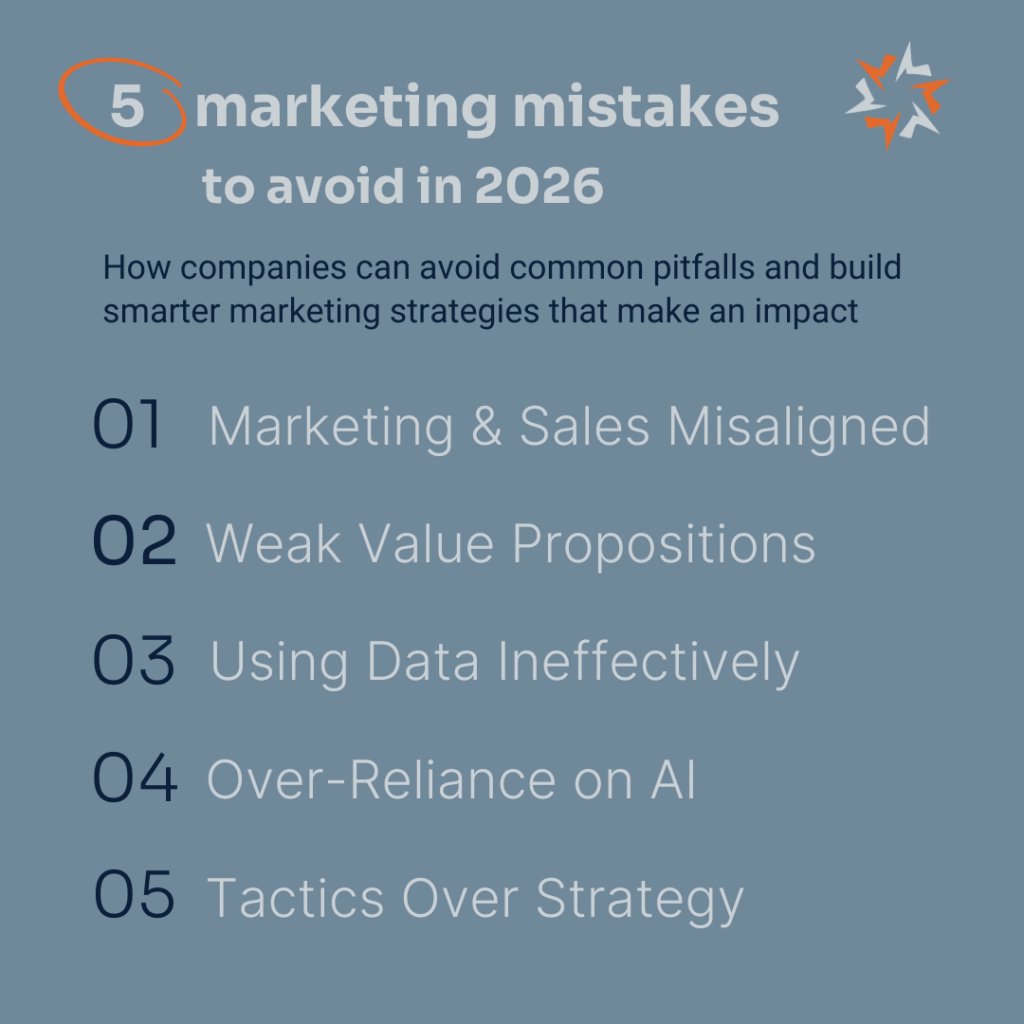
Understanding some of the most common marketing mistakes can help companies maximize their budget and create marketing programs that move the need. Here are five critical marketing pitfalls businesses should avoid in 2026 as they look for marketing success.
1. Poor Alignment Between Marketing and Sales
We see this one all too often: organizations failing to align their marketing and sales teams. Although both departments share the goal of driving revenue, they often operate in silos with different priorities, metrics and messaging.
Marketing teams frequently focus on lead gen, while sales teams concentrate on closing deals. When these objectives are not in synch, marketing may produce leads that sales teams consider unqualified or off target, while the sales team may ignore valuable marketing resources designed to support their client cultivation efforts.
These disconnects lead to inconsistent messaging, inefficient lead management and missed opportunities throughout the marketing funnel. Even worse, prospective customers may receive conflicting information, weakening trust and lowering conversion rates.
Successful companies address this issue by creating a shared revenue strategy. Marketing and sales teams work hand-in-hand on defining customer profiles, lead qualification standards and performance metrics. By aligning messaging, goals and reporting systems, sales-driven organizations can create a seamless buyer experience that improves both lead quality and closing rates.
2. Weak or Unclear Value Propositions
In crowded and competitive markets, it’s integral that businesses communicate clearly why their products or services stand out. Unfortunately, many companies rely on generic messaging that fails to differentiate their brand.
Phrases like “high-quality service,” “industry-leading solutions” or “customer-focused approach” appear frequently across websites and marketing materials. While these statements sound professional, they provide little meaningful information to potential customers.
Modern buyers expect clarity and specificity. If a company cannot quickly explain what problem it solves and why its solution is superior, prospects are likely to move on to competitors with stronger messaging.
A compelling value proposition clearly addresses the customer problem, offers a solution, and communicates the unique advantage the business or service provides. Strong messaging focuses on outcomes rather than features, explaining the all-important tangible benefits customers can expect.
When businesses define their value proposition and use it consistently, they improve not only on conversions but also the effectiveness of advertising, sales collateral and overall brand positioning.
3. Ignoring Data or Using It Ineffectively
Data continues to be one of the most valuable – and underutilized – resources in marketing. With analytics platforms tracking nearly every aspect of customer behavior, businesses have unprecedented insight into buying intention and campaign performance.
However, many organizations either ignore available data or focus on the wrong metrics. Some companies make decisions based on intuition rather than analytics, while others collect large amounts of data but fail to interpret it (or even use it) effectively.
This often results in marketing teams focusing on metrics like impressions or clicks instead of indicators that drive real revenue. Without defined measurement frameworks, companies struggle to understand which campaigns produce meaningful results.
A strong data-driven marketing strategy prioritizes metrics that directly impact business performance. These include customer acquisition cost, conversion rates, marketing-attributed revenue and customer lifetime value. Companies that leverage these kinds of metrics can identify successful campaigns, optimize budgets and scale strategies that produce measurable growth.
4. Over-Reliance on Automation and AI
Artificial intelligence and marketing automation tools can transform how businesses create and manage campaigns. These technologies allow teams to generate content faster, personalize messaging at scale and optimize advertising performance in real time.
While these tools offer tremendous advantages, relying on automation without strategic oversight can lead to ineffective marketing (or just make your efforts seem lazy). AI-generated content often lacks originality and brand personality, while automated campaigns may overlook important nuances in customer behavior.
Effective marketing programs combine the efficiency of automation with strategic thinking and human creativity. AI should support marketing teams by handling repetitive tasks and providing data insights, while human marketers focus on storytelling, brand development and long-term strategy.
Maintaining the proper balance lets businesses scale marketing efforts without sacrificing authenticity or quality.
5. Prioritizing Tactics Over Strategy
Another all-to-common mistake is chasing marketing tactics without first having a clear and well-defined marketing strategy. With new channels and technologies continually emerging along with the need for traditional deliverables like websites, email campaigns and collateral, it’s easy to spread marketing efforts too thin. Many companies often rush to adopt these platforms before determining whether they align with their audience or objectives, as well as the commitment required to be successful.
As a result, marketing efforts become unfocused, scattered across too many channels. Time, budgets and resources are divided between platforms without a clear understanding of which ones produce the best results. Messaging also becomes inconsistent as campaigns are adapted for multiple environments without a unified strategy.
Successful marketing begins with strategic clarity. Businesses must first identify their ideal customers, understand their needs, and define the key stages of their buying journey. After this foundation is established, then organizations select and prioritize the marketing channels that best support their strategy.
When the tactics are part a strategic plan, marketing campaigns become more focused, efficient and impactful.
Building a Smarter Marketing Strategy for 2026
While the marketing landscape continues to evolve rapidly, the core fundamentals of effective marketing strategy remain consistent. Businesses that align their teams, clarify their messaging, leverage meaningful data, and balance automation with human creativity are far more likely to succeed.
Avoiding these common marketing mistakes allows organizations to focus resources on initiatives that truly drive growth. Instead of reacting to trends, successful companies build structured marketing programs to help deliver desired results.
At JAB Marketing, we help businesses develop strategic marketing programs designed to increase brand visibility, generate qualified leads and drive measurable revenue growth. If you’re looking to avoid the mistakes we’ve outlined and level-up your marketing efforts, contact JAB@JABMarketing.co to discuss how we can help you make an impact.