
AI is rapidly transforming how commercial real estate and financial services firms approach marketing. Investor communications, market reporting, lead generation, content creation, CRM management and campaign analytics are all evolving – and becoming more efficient – through AI-powered tools and automation.
As adoption accelerates, everyone seems to be asking the same question:
“Can’t we just use AI for our marketing?”
Not exactly…
AI can definitely improve efficiency, automate repetitive workflows and enhance data analysis. For marketers managing complex campaigns, capital raise pipelines and multi-platform communication strategies, these tools can create meaningful operational and productivity advantages.
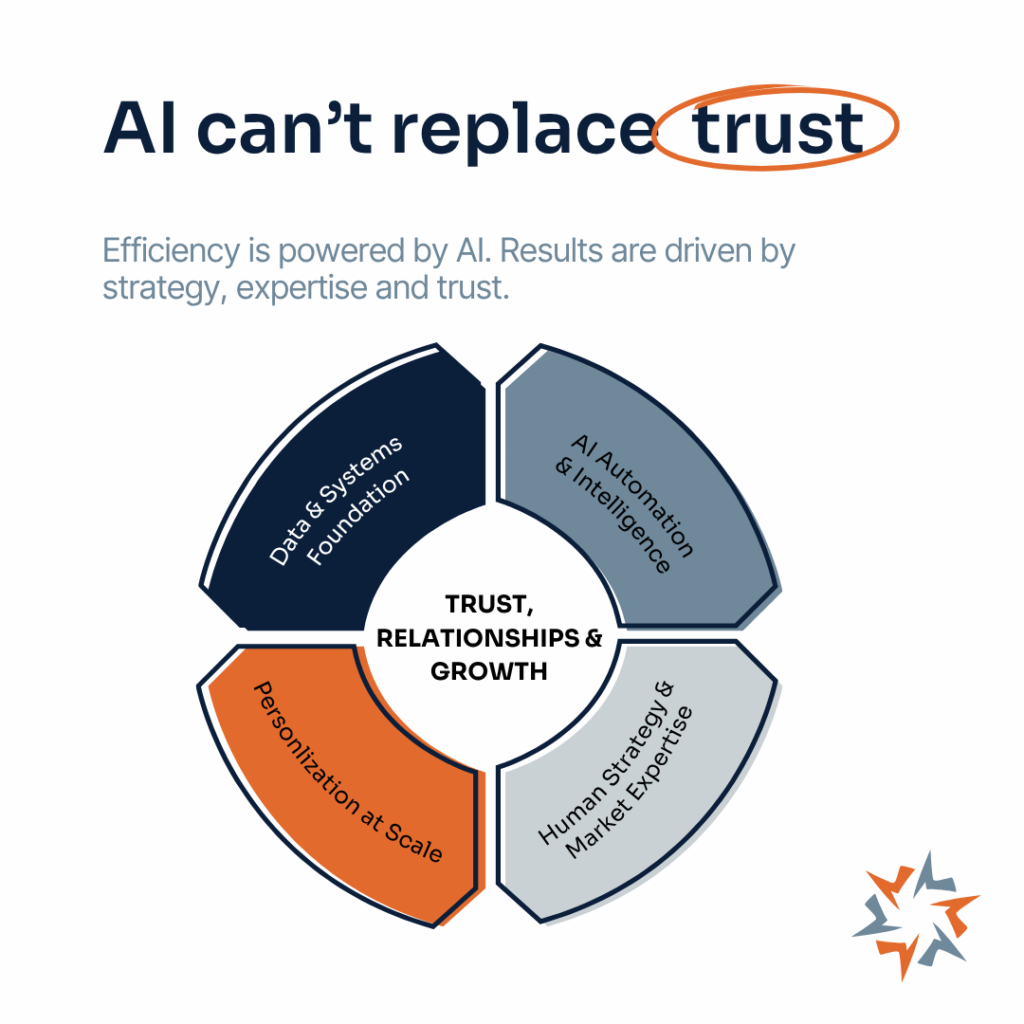
While AI can improve execution, it has not (yet) replaced strategic thinking, market expertise or relationship-driven communication. In industries like commercial real estate and investment management, those elements remain essential to building trust and generating opportunity.
The companies seeing the strongest results today are not replacing marketing strategy with AI. They are using AI to eliminate inefficiencies while strengthening the areas where human expertise matters most.
Intelligent Personalization
One of the most significant shifts AI is creating is not simply automation, but intelligent personalization at scale.
Traditional marketing automation platforms have long been capable of scheduling emails and triggering workflows based on user behavior. What AI adds is the ability to dynamically adapt messaging, content and communication strategy based on engagement patterns and predictive analysis.
For commercial real estate and financial services firms, this creates entirely new opportunities to personalize investor and stakeholder communication. For example, AI-powered platforms can analyze how different audiences engage with content and automatically adjust future messaging accordingly. An institutional investor consistently interacting with industrial market commentary may begin receiving more logistics-focused insights, while a private investor interested in mixed-use developments may see different project updates, case studies or market forecasts.
Platforms such as HubSpot AI, Salesforce Einstein, Adobe Experience Cloud and Dynamic Yield now support predictive personalization capabilities that allow organizations to adapt messaging based on behavioral signals, engagement timing, historical interactions and likely intent.
Website personalization is another rapidly growing application. AI-driven platforms can dynamically change homepage messaging, featured content or calls-to-action depending on a visitor’s industry, geography, referral source or prior engagement history. A broker, municipal stakeholder and institutional investor may all visit the same website but encounter different content experiences optimized for their priorities.
This level of personalization was previously difficult and resource-intensive to execute at scale. AI is making it significantly more accessible.
AI as a Content and Workflow Accelerator
AI is also significantly improving content production workflows. Tools like ChatGPT, Claude, Grammarly and Copy.ai can accelerate blog development, market commentary drafts, social media planning and investor communications.
For firms producing recurring thought leadership content, quarterly market outlooks or investment commentary, AI can help reduce production timelines. Tasks that previously required detailed fact gathering and analysis followed by multiple rounds of drafting and editing can now move from concept to first draft in a fraction of the time.
AI is also improving internal operational efficiency. Investment management firms are beginning to use AI-powered reporting tools to generate customized investor summaries based on portfolio preferences, geographic exposure or asset class focus. Instead of sending identical quarterly updates to every stakeholder, firms can deliver more relevant insights tailored to specific investor interests.
Used properly, these tools allow marketing teams to focus less on repetitive production tasks and more on strategic direction, positioning and relationship-building.
All of this does not eliminate the need for human oversight. In many ways, strategic insight and editing becomes even more important. AI-generated content often lacks brand voice, market nuance and contextual understanding. It can sound polished while still feeling generic.
That distinction matters in industries where credibility and expertise directly influence decision-making.
AI-Driven Analytics and Predictive Intelligence
AI is also changing how organizations interpret and act on marketing intelligence.
Traditional analytics platforms have long provided performance dashboards and historical reporting. What AI introduces is the ability to synthesize large volumes of fragmented data, identify emerging patterns and generate actionable recommendations in real time.
Rather than manually reviewing reports across multiple platforms, AI-powered systems can identify shifts in investor engagement, detect changing audience behavior and surface opportunities that may otherwise go unnoticed.
Consider an investment management firm using AI to analyze engagement trends across investor communications, website activity, email engagement and market report downloads. The system may identify increasing interest in certain content topics among a specific client segment much quicker than traditional reporting would surface the trend.
Similarly, brokerage and development firms can use AI-powered intelligence tools to identify changing engagement patterns tied to geographic markets or asset classes or and adjust their communication strategy proactively.
Where Human Expertise Still Matters
Despite these advancements, AI still has clear limitations.
In commercial real estate and investment marketing, relationships and trust continue to drive decision-making. AI can support communication, but it cannot replace market experience, strategic judgment, authentic thought leadership or that face-to-face interaction.
Investors are evaluating expertise, perspective and confidence. They want performance grounded in experience, not recycled information generated at scale.
The same principle applies to brand positioning. One of the greatest risks organizations face when over-relying on AI is the erosion of differentiation. AI-generated messaging often sounds polished, but interchangeable. Over time, firms relying too heavily on automation risk blending into increasingly crowded markets.
Strong positioning still requires human perspective to understanding local market dynamics, client psychology, stakeholder priorities and long-term business objectives. These are strategic considerations AI cannot independently navigate.
Strategy Still Drives Results
AI is not replacing marketing, but it is reshaping how marketing operates.
For commercial real estate and financial services firms, the opportunity is not to automate everything. The opportunity is to remove hurdles, improve scalability and allow your teams to focus more energy on strategy, relationships and high-value decision-making.
The organizations gaining the greatest advantage from AI today are not the ones attempting to automate their entire marketing function. They are the ones combining technology with strong strategic foundations.
At JAB Marketing, we help organizations navigate that balance. From positioning and content strategy to digital execution and stakeholder engagement, we work with clients to integrate modern marketing tools without losing the expertise, credibility and human insight that drive long-term growth. Give us a shout at JAB@JABMarketing.co to connect with a real person.
While AI can make marketing more efficient, trust is still built by people (like me).