A new era of lead generation is upon us. Visibility alone no longer drives growth. The core factor is now credibility.
Across commercial real estate, financial services and B2B industries, prospective clients are engaging with companies that demonstrate expertise, communicate with clarity and provide measurable evidence of impact. Traditional outreach tactics built on volume and promotion are giving way to strategies rooted in authority, value and strategic alignment.
The shotgun approach of days past proves less and less successful. Ultimately, businesses attracting new clients and generating more revenue aren’t increasing activity; they are strengthening the confidence and direction of their message.
Here are six strategies that can produce measurable results – and help you make an impact – in today’ marketing playbook.
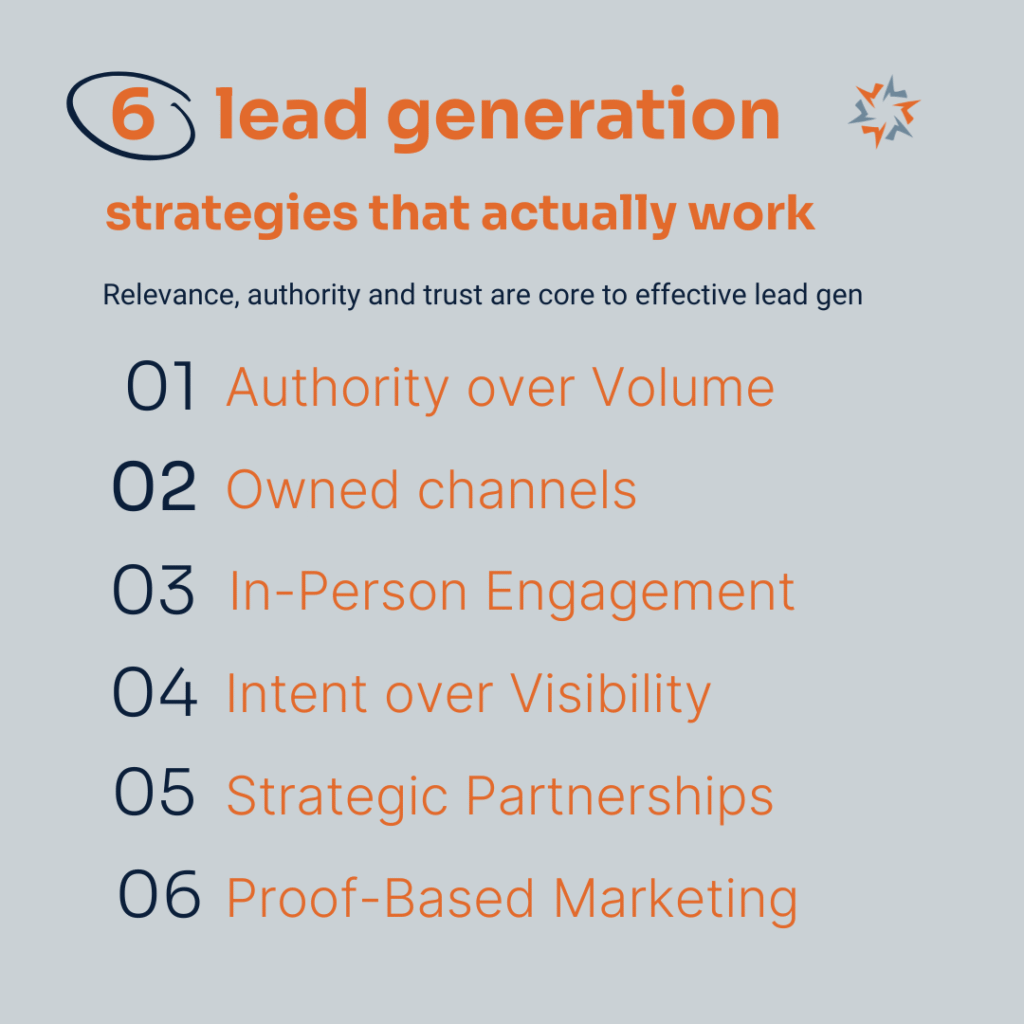
1. Authority Content Has Replaced High-Volume Content
Decision-makers are not seeking more information. They are seeking information that’s important and relevant to them. Businesses that publish original insights, market analysis and project-level transparency consistently generate stronger inbound engagement than those relying on promotional messaging. Consider these factors:
- 71% of B2B buyers consume multiple pieces of content before initiating contact. (Sopro.io)
- Thought leadership increases purchase intent among senior decision-makers by more than 40%. (thinkshift.com)
- Proprietary insights can generate up to three times more qualified leads than general marketing content, while highlighting the expertise of your team. (MEmob.com)
So, if authority is established through relevance and evidence, not volume, what type of content can drive interactions? Consider these types of materials:
- Market outlook reports
- Project or key initiative updates
- Investor-focused performance insights
- Sector trend analysis that reflects real activity and insights
2. Owned Audiences Are the Most Reliable Pipeline
With organic reach seeing declines across many platforms, direct (or “owned”) communication channels are now essential marketing platform infrastructure. Organizations that cultivate their owned audiences through valuable content, video, social media, email, leadership updates and direct engagement can maintain consistent and direct access to decision-makers.
For example, research shows that Email marketing is still an effective tool, averaging a $36 return for every $1 invested (Forbes). But segmented campaigns drive substantially higher engagement and conversion than general blasts that lack focus (Fishbat) and consistency in communication produces more sales-ready opportunities at lower acquisition cost (Adobe). Keep in mind that consistency doesn’t mean a flow of non-stop emails; it’s providing valuable information on a regular basis. Types of content that can perform well include:
- Market insight briefings
- Project lifecycle communications
- Investor and partner updates
- Audience-specific messaging strategies
When communication delivers insight rather than promotion, engagement compounds over time.
3. In-Person Engagement Accelerates Decisions
Experience still matters, given that trust is built through context and interaction. Experience-driven engagement has re-emerged as a primary conversion catalyst. From in-person conferences and events to webinars and podcasts, potential clients want to know who they are doing business with. That’s why:
- In-person experiences are consistently ranked among the most trusted information sources by B2B decision-makers. (McKinsey.com)
- Event-generated opportunities convert at significantly higher rates than digital-only leads. (Beamian.com)
- Relationship-centered engagement shortens decision timelines (Brixon Group)
In-person engagement can be as simple as phone calls, videoconferencing, webcasts or even going to lunch. Traditional industry trade shows and conferences can allow you to connect with larger numbers of liked-minded peers or showcase your products, services and talents to your prospects, clients or stakeholders. On the commercial real estate side, site tours and project walkthroughs can help bring a development to life and celebrating development milestones with appropriate events drive goodwill and shared accomplishments. Other opportunities include stakeholder briefings, investor roundtables and community engagement presentations.
4. SEO Now Prioritizes Intent Over Visibility
Just when you think you have SEO maximized, the game changes. Search behavior has shifted from exploration to evaluation, making valuable content even more important. Organizations generating the most beneficial inbound opportunities align content with decision-stage questions rather than broad topical coverage. When it comes to SEO, we’re now seeing:
- High-intent search queries converting multiple times more frequently than general informational searches. (SEOforGrowth.com)
- Local and industry-specific expertise content producing the highest lead quality in CRE and B2B sectors. (Medium.com)
- Comprehensive, insight-driven content sustaining rankings and engagement over longer periods. (BrightEdge.com)
So, what kind of content works? Consider comprehensive, evergreen content that answers long-tail questions; how-to guides and tutorials that solve specific problems; listicles that provide clear, digestible information; visual rich content that incorporates infographics, videos and original images; and “answer-first” content that places the meat of your take at the top of your page in easy-to-digest snippets.
5. Strategic Partnerships Function as Lead Channels
Just like in-person engagement can prove beneficial, leveraging your network of stakeholders, clients and partners can drive lead generation. Research shows that over 90% of B2B buyers admit they’re influenced by word of mouth and referred clients have 18% less churn. And these deals tend to close faster and result in higher average deal values when generated through partner opportunities (Partner2b.com). Ultimately, organizations with structured partnership strategies achieve faster growth — up to 2.5 times faster revenue growth than peers — by leveraging shared resources, expanding into new markets, and fostering innovation (SanguineUSA.com). At the end of the day, partnership alignment extends market reach while reinforcing credibility.
Depending on your industry and business focus, partner opportunities may come in different forms. Within CRE, brokers, investors, economic development organizations, industry associations and, of course, clients, can serve as logical partner opportunities. Financial services companies have the opportunity to leverage their existing investor base, as well as strategic alliances with businesses targeting similar-type customers.
6. Proof-Based Marketing Outperforms Promotional Messaging
Modern decision-makers expect evidence. Organizations that communicate measurable outcomes consistently outperform those relying on positioning alone. These can include trust-building elements, performance metrics and benchmarks, economic impact indicators, before-and-after comparisons and visual reporting dashboards. Demonstrated results convert interest into action.
Conclusion: Credibility Is the New Growth Engine
Lead generation in 2026 is no longer driven by reach, but rather by relevance, authority and trust. Effective marketing is now a trust-building system, one that attracts the right audiences, strengthens partnerships and supports long-term growth.
Organizations generating consistent, high-quality opportunities are those that demonstrate expertise, cultivate direct relationships and substantiate their value with measurable proof. They are not pursuing attention. Instead, they are focused on earning confidence.
The advantage belongs to organizations that lead with insight, communicate with transparency and align strategy with outcomes. If you’re looking to generate more leads for your business, contact JAB@JABMarketing.co to discuss how we can help you make an impact.